Case Study: Writing VENU
Role: UX writer and content designer (solo project) · Scope: Product copy, terminology, content inventory (161 strings), user guide, release notes · Tools: Oracle JET, Notion, Astro, Starlight
The problem
Section titled “The problem”VENU is a web app for finding events, claiming guest-list tickets, and transferring tickets to someone else when plans change. It started as a Figma prototype.
Copy written against static frames never meets the constraints of a real build: what an empty state renders as, or whether a label still reads right once it shows real data instead of a mockup. To write content that holds up, I needed a product that runs.
The solution
Section titled “The solution”I approached this in four areas: building the product, managing the content, reconciling it with what shipped, and documenting it.
1. Building the app
Section titled “1. Building the app”I built and deployed VENU with Oracle JET. It is live at app.techcomm.dev, with sign-in, an event catalog, ticket claiming, and transfers between accounts.
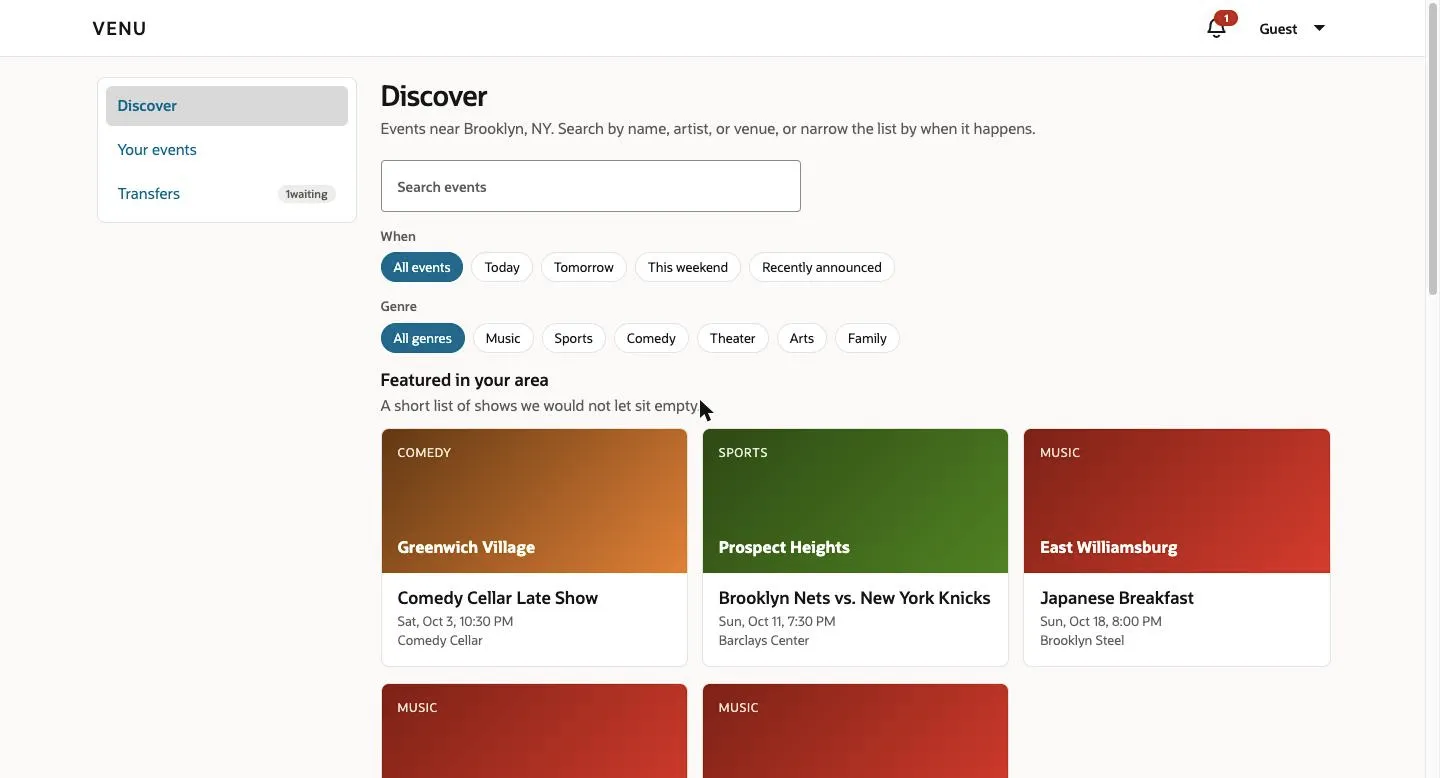
Building it meant every string had to survive real data, real empty states, and small screens. It also meant I decided how content and code stay in sync, not only what the words say.
2. Keeping one source of truth for every string
Section titled “2. Keeping one source of truth for every string”I keep a content inventory in Notion: 161 strings across five user journeys: Sign In, Find and Claim, Transfer Tickets, Hold Tickets, and Account and Help. Each string is keyed to the file it lives in, so a change in the inventory maps to one place in the app.
This is the same discipline I apply to the SOA Suite documentation at Oracle: one owner and one source for each piece of content.
3. Reconciling content with what shipped
Section titled “3. Reconciling content with what shipped”When I rebuilt sign-in as a passwordless, magic-link flow, the inventory and the repository still described the old password form. I reconciled all three against the component source: I updated the stale strings and added the ones that were missing.
It is the same problem I found auditing the Oracle Integration adapter finder: documentation drifts from what shipped unless a process brings the two back together.
4. Documenting the app
Section titled “4. Documenting the app”I wrote a task-based user guide and Version 1.0 release notes against the live app. The guide covers signing in, finding events, claiming tickets, and sending and accepting transfers. The release notes describe what launched in the voice a shipped product would use.
Results
Section titled “Results”- A live product. VENU runs at a public URL, and the guide and release notes are written against it.
- One source of truth. All 161 strings live in a single inventory, organized by user journey and mapped to their files.
- No drift. The magic-link sign-in is reflected in the app, the inventory, the repository, and the guide.
Live app
Section titled “Live app”You can use VENU at app.techcomm.dev. Select Continue as guest to explore with sample tickets, no account required.